Name
Frederick James Chappell
11 January 1894
Conflict
First World War
Date of Death / Age
01/09/1918
23
Rank, Service Number & Service Details
Private
2631
Australian Infantry, A.I.F.
56th Bn.
Awards: Service Medals/Honour Awards
Searched but not found
Cemetery/Memorial: Name/Reference/Country
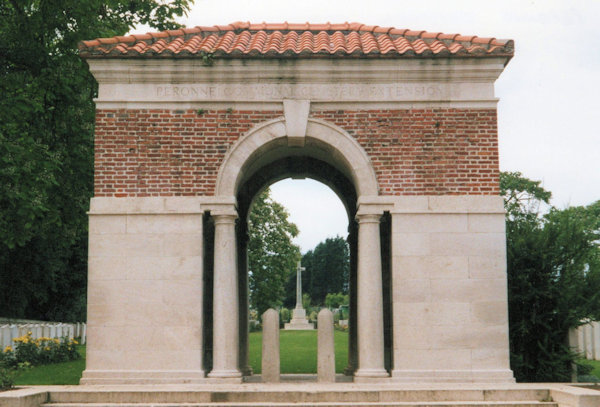
PERONNE COMMUNAL CEMETERY EXTENSION
II. C. 52.
France
Headstone Inscription
None
UK & Other Memorials
Anstey Village Memorial,
St George's Church Memorial, Anstey,
Diocese - Book of Remembrance, St Albans Cathedral, St Albans (TBC),
Diocese of St Albans - ROH, St Albans Cathedral, St Albans
Pre War
Frederick James Chappell was born in Anstey, Hertfordshire on 11 January 1894, (with his twin sister Ethel Rose) the son of James and Sarah Chappell (nee Martin) of Anstey, Herts and one of nine children.
On the 1901 Census the family were living in Anstey village, where his father was working as an agricultural labourer. They remained in Anstey in 1911 and were living at Cheapside at which time Frederick was working as a farm labourer.
His father died in early 1914, and Frederick departed from London on 1 July 1914 to Brisbane, Australia, on the Euripedes, a steamship of the Aberdeen Line.
His 'sister', Mrs Ruby Constance Buchanan, of 23 St George Crescent, Drummoyne, New South Wales, Australia was given as next of kin on the Australian Imperial Force Nominal Roll. It seems she was not a blood relation but the wife of Jack Buchanan, mother of 4 children and he was living with Jack and Ruby when he enlisted. He also made a will naming Ruby as beneficiary of all his assets.
At the time of his death his mother was living in the School House, Anstey, near Buntingford, Herts.
Wartime Service
Frederick, who had been working as a clerk, enlisted 26 May 1916 in Sydney, New South Wales and went to Codamundra for training, eventually joining A company, 56th Battalion from 4 September 1916. He left Sydney on 7 October 1916 on the ship A40 Ceramic, arriving at Plymouth, England on 21 November 1916. He then left Folkestone, Kent on SS Princess Victoria on 22 December 1916 arriving at Etaples, France the following day. Once in France he was taken on strength on 7 February 1917 and spent a short time at carrier pigeon school.
In November 1917 he was sent to hospital suffering from myalgia, eventually being sent to England on 19 November as he was suffering from trench fever and anaemia with leg pains and shivers, and was admitted to the Southern General Hospital, Birmingham on 21 November, and discharged on 13 December 1917. Having recovered, he was returned to France via Southampton on 4 March 1918 arriving at Le Havre the following day and re-joining the 56th battalion in the field on 9 March.
He was wounded in action by gas on 1 June 1918 and initially admitted to the 47th & 55th Casualty Clearing Stations and finally to the 12th General Hospital in Trouville, Rouen on 11 June 1918. His service record suggests that he was gassed again the following month but after treatment re-joined his unit in the field on 20 August 1918.
Frederick was killed in action on 1 September 1918, aged 23, during the early stages of the attack on Peronne. Machine gun fire was extremely heavy and he received a bullet in the head and died instantly. He is buried in Peronne Communal Cemetery Extension, France.
Additional Information
His older brother Harry (Henry) Chappell, served with the Bedfordshire Regiment from 1903 and was transferred to the Army Reserve in 1906. He had emigrated to Australia in 1910 and at the outbreak of war he reported for mobilisation in Australia as a Lance Corporal on 10 August 1914.
Acknowledgments
Brenda Palmer
Malcolm Lennox, www.awm.gov.au/search/, naa.gov.au, www.ansteyvillage.co.uk