Name
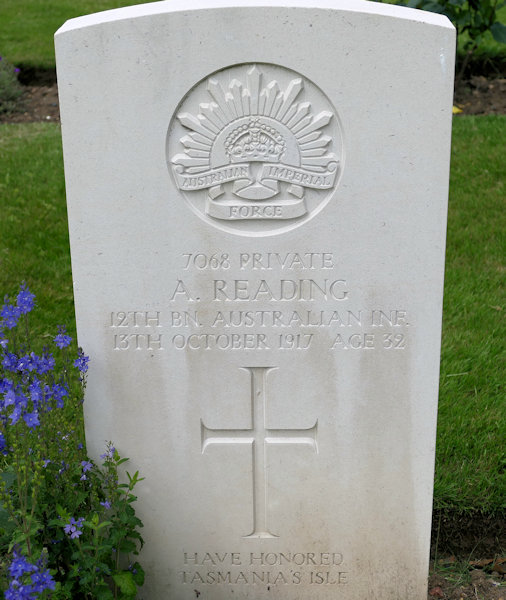
Alexander Reading
Conflict
First World War
Date of Death / Age
13/10/1917
32
Rank, Service Number & Service Details
Private
7068
Australian Infantry, A.I.F.
12th Bn.
Awards: Service Medals/Honour Awards
Not Yet Researched
Cemetery/Memorial: Name/Reference/Country
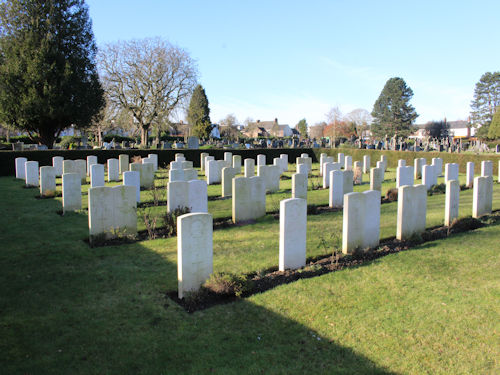
ST. ALBANS (HATFIELD ROAD) CEMETERY
Mil. G. 2.
United Kingdom
Headstone Inscription
Not Researched
UK & Other Memorials
Not on the St Albans memorials (*1)
Biography
Alexander Reading was born at Hobart, Tasmania on 4th September, 1885 to parents Edward James & Mary Reading (nee Robinson).
Alexander Reading attended Macquarie Street State School, South Hobart, Tasmania & also Technical School, Hobart, Tasmania.
The 1914 Australian Electoral Roll for the division of Denison, sub-division of Hobart South, Tasmania recorded Alexnder Reading, Capenter, of 50 Forest Rd. Also listed at that address – Edward James Reading, Carpenter & Edward James Reading, junior, Carpenter.
Alexander Reading was a 31 year old, single, Bricklayer from Hobart, Tasmania when he enlisted on 16th October, 1916 at Claremont, Tasmania with the Australian Imperial Force (A.I.F.). His religion was Presbyterian & his next of kin was listed as his father – Mr E. J. Reading, 50 Forrest Road, Hobart, Tasmania.
Private Alexander Reading, Service number 7068, embarked from Melbourne, Victoria on HMAT Persic (A34) on 22nd December, 1916 with the 12th Infantry Battalion, 23rd Reinforcements & disembarked at Devonport, England on 3rd March, 1917.
Reinforcements were only given basic training in Australia. Training was completed in training units in England. Some of these were located on the Salisbury Plain & surrounding areas in the county of Wiltshire.
Private Alexander Reading was marched in to 3rd Training Battalion at Durrington, Wiltshire on 3rd March, 1917.
Private Alexander Reading proceeded overseas to France via Southampton on 14th June, 1917 from 3rd Training Battalion at Durrington. He was marched in to 1st A.D.B.D. (Australian Divisional Base Depot) at Havre, France on 15th June, 1917. Private Reading proceeded from 1st A.D.B.D. on 28th June, 1917 & joined 12th Battalion in France on 7th July, 1917.
Private Alexander Reading was wounded in action in Belgium on 19/20th September, 1917. He was admitted to 6th Australian Field Ambulance on 20th September, 1917 with shrapnel wound/s to left Buttock. Private Reading was transferred & admitted to 35th General Hospital at Calais, France on 23rd September, 1917. He was listed for transfer to England on 7th October, 1917 & embarked for England on 8th October, 1917 on Hospital Ship Ville de Liege.
12th Battalion
The 12th Battalion was among the first infantry units raised for the AIF during the First World War. Half of the battalion was recruited in Tasmania, a quarter was recruited in South Australia, and a quarter from Western Australia. With the 9th, 10th and 11th Battalions it formed the 3rd Brigade.
In 1917 the battalion took part in the brief advance that followed the German Army's retreat to the Hindenburg Line. For their valorous actions near Boursies during this advance, Captain J. E. 'Jim' Newland, commanding A Company, and Sergeant J. W. Whittle were each awarded the Victoria Cross. The battalion subsequently returned to Belgium to participate in the offensive that became known as the Third Battle of Ypres.
(Extract of Battalion information from the Australian War Memorial)
War Diary – 12th Battalion
19 September 1917 – Halfway House:
Move to Halfway House. Move completed by 155. Men all resting in afternoon & evening.
20/21 September 1917- Front Line:
There is a detailed Operational Report in the war Diary.
Private Alexander Reading was admitted to the County of Middlesex War Hospital, Napsbury, St. Albans, Hertfordshire, England on 8th October, 1917 with shrapnel wound/s to buttock. He was reported to be dangerously ill. The Hospital Admissions form recorded he was admitted with “Multiple shrapnel wounds to Back, both Buttocks & both Thighs”. “Septicaemia – multiple incisions for drainage – profuse pus discharge from wounds. Sever secondary haemorrhage from rt thigh wounds. Death.”
Mr E. J. Reading, 50 Forest Road, Hobart, Tasmania was advised by Base Records on 8th October, 1917 that Private A. Reading had been wounded.
Private Alexander Reading died at 11.45 pm on 13th October, 1917 at the County of Middlesex War Hospital, Napsbury, St. Albans, Hertfordshire, England from wounds received in action in France – multiple shell wounds with injury to blood vessels & Hemorrhage. He died whilst under operation.
A death for Alexander Reading, aged 32, was registered in the December quarter, 1917 in the district of St. Albans, Hertfordshire, England.
Miss L. Westbury, Highbury Hospital, Da___ St, Hobart, wrote to Base Records (letter undated but was received at Base Records on 15th October, 1917) with the following: “Would you kindly let me know if Private A Reading No 7068 12th Battalion Australian Imperial Force is wounded badly or only slight as I am his young ladie and would like to know. As I am very worried about him hoping I am not asking to much I remained yours in the C_____ L. Westbury his mother as asked me to asked also so I am nit taking the note on my hone hands.”
Private Alexander Reading was buried at 3 pm on 18th October, 1917 in Hatfield Road Cemetery, St. Albans, Hertfordshire, England – Plot number G. 2. Soldiers Corner.
The burial place is now recorded by CWGC as Mil. G. 2. and he now has a Commonwealth War Graves Commission headstone.
From the burial report of Private Alexander Reading - Coffin was good, polished Elm. The deceased soldier was accorded a Military Funeral, Gun Carriage being supplied by 309th Coy Army Service Corps stationed at St. Albans and the Firing Party by 3rd Battalion Herts Volunteer Regt. A service was conducted at the graveside by Rev. Chadwick, D.D., (C. of E.) Senior Chaplain, Napsbury War Hospital. No relatives were present at the funeral. A wreath was sent by Hospital Patients.
The Red Cross Wounded & Missing file for Private Alexander Reading contains a letter from The Officer Commanding, County of Middles War Hospital, Napsbury, St. Albans which reads: “Re 7068 Pte A. Reading, 12th Battn. He was admitted to this Hpl. From France on 8-10-17 suffering from Multiple Shrapnel Wounds – buttocks, both thighs and lumbar region of back. He was also suffering from General Sepsis. He was considered to be dangerously ill on admission. Operations were performed in an endeavour to relieve his condition but he made no improvement and died on 13-10-17. A Military funeral was arranged and took place at St. Albans Cemetery on 18¬10-17. Particulars of the grave are as follows:- Section – Soldiers Corner – Grave No. G.2.”
Private Alexander Reading requested in his Will dated 13th July, 1917 that all his personal estate be bequeathed to his mother – Mary Reading, 90 Forest Road, Hobart, Tasmania.
Private Alexander Reading was entitled to British War Medal & the Victory Medal. A Memorial Scroll & Memorial Plaque were also sent to Private Reading’s father – Mr E. J. Reading, as the closest next-of-kin. (Scroll sent 20th September, 1922 & Plaque sent 18th September, 1922).
The Commonwealth War Graves Commission lists Private Alexander Reading– service number 7068, aged 32, of 12th Battalion, Australian Infantry. He was the son of Edward James & Mary Reading, of 90 Forest Rd, Hobbart, Tasmania.
Acknowledgments
Gareth Hughes, Jonty Wild, Cathy Sedgwick, Beth Page - https://ww1austburialsuk.weebly.com/