Name
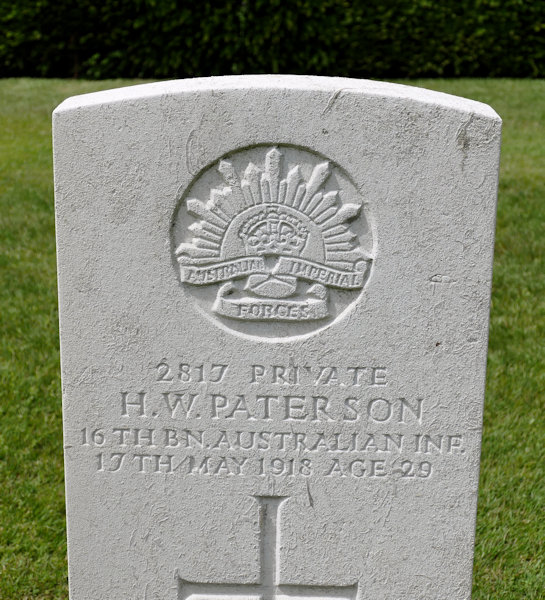
Harold Walter Paterson
Conflict
First World War
Date of Death / Age
17/05/1918
29
Rank, Service Number & Service Details
Private
2817
Australian Infantry, A.I.F.
19th Bn.
Awards: Service Medals/Honour Awards
Not Yet Researched
Cemetery/Memorial: Name/Reference/Country
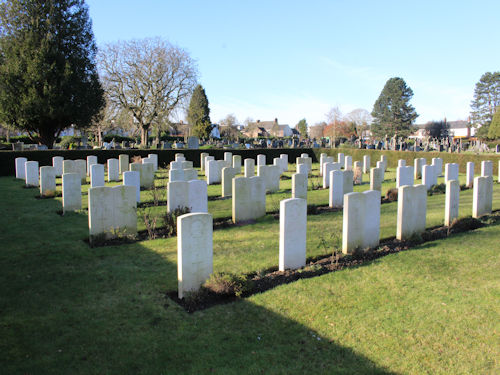
ST. ALBANS (HATFIELD ROAD) CEMETERY
Mil. B. 5.
United Kingdom
Headstone Inscription
Not Researched
UK & Other Memorials
Not on the St Albans memorials (*1)
Biography
Harold Walter Paterson was born at Ballarat, Victoria, Australia in mid-1889 to parents John George & Lucy Ann Paterson (nee Lucas).
Harold Walter Paterson was a 26 year old, single, Labourer when he enlisted at Keswick, South Australia on 14th July, 1915 with the Australian Imperial Force (A.I.F.). His religion was Church of England & his next of kin was listed as his mother – Mrs L. Paterson, West Port, West Coast, New Zealand.
Private Harold Walter Paterson was posted to “M” Group Base Infantry on 14th July, 1915 for recruit training. He was transferred to 9th Reinforcements of 16th Infantry Battalion on 16th August, 1915.
Private Harold Walter Paterson, Service number 2817, embarked from Adelaide, South Australia on HMAT Star of England (A15) on 21st September, 1915 with the 16th Infantry Battalion, 9th Reinforcements & disembarked on 28th October, 1915.
Private Harold Walter Paterson was taken on strength of “Fd Refn” at Ismalia on 8th January, 1916.
Private Harold Walter Paterson was transferred & taken on strength of 48th Battalion at Tel-el-Kebir on 13th March, 1916. He was transferred to 12th Infantry Brigade Machine Gun Company on 19th March, 1916 & was taken on strength the same day.
Private Harold Walter Paterson was marched out to Machine Gun Training Depot on 25th May, 1916.
Private Harold Walter Paterson was transferred to 16th Battalion on 29th May, 1916 & was taken on strength of 16th Battalion at Serapeum on the same day from Machine Gun Company.
Private Harold Walter Paterson proceeded from Alexandria on 1st June, 1916 to join B.E.F. (British Expeditionary Force) & disembarked at Marseilles, France on 9th June, 1916.
Private Harold Walter Paterson was wounded in action on 10th August, 1916 with an injury to his Knee. He was admitted to 3rd Casualty Clearing Station on 10th August, 1916 & transferred to Ambulance Train on 11th August, 1916. Private Paterson was admitted to 10th General Hospital at Rouen, France on 12th August, 1916. He was marked for transfer to England on 17th August, 1916 & embarked from Havre, France on 18th August, 1916 on Hospital Ship Maheno with G.S.W. (gunshot wound/s) to right knee.
16th Battalion
The 16th Battalion AIF was raised from 16 September 1914, six weeks after the outbreak of the First World War. Three-quarters of the battalion were recruited in Western Australia, and the rest in South Australia. With the 13th, 14th and 15th Battalions it formed the 4th Brigade commanded by Colonel John Monash.
In June 1916 they sailed for France and the Western Front. From then until 1918, the battalion took part in bloody trench warfare. Its first major action in France was at Pozieres in the Somme valley, where Private Martin O'Meara won the battalion's first Victoria Cross
(Extract of Battalion information from the Australian War Memorial)
War Diary – 16th Battalion
HEADQUARTERS X.4.a.7.9. August 10, 1916:
12 midnight – Attack launched on CIRCULAR TRENCH 78. 79.
2.50 am – Reported to 4th Brigade Headquarters as per a.D.102. (War Diary appendix 1)
3.50 am – Reported operation successful everywhere as per A.D. 104. (War Diary appendix 2). Captured 50 prisoners, 3 Machine Guns and a Gas Plant and Fire Plant.
12.14 pm – Reported in reply to query from Headquarters 4th Australian Infantry Brigade, that none of TRENCH 33.D.7.S to 33.B.6.1 in our possession but could get same at any moment.
12 noon – Reported that we had taken over RATION TRENCH between 77 and 26 from the 7th SUFFOLKS
4.55 pm – Enemy actively engaged in shelling our new positions. Looked like preparation for a counter attack. Asked for four (4) Vickers Machine Guns.
5 pm – Conference of Company Commanders with Commanding Officer re operations for night 10/11th. Battalion task, make good POINT 13. In R.34.a. and POINT 61.R.33.b and also link up POINTS 78 and 28, in R.33.d. The zero time was 1 am night 10th/11th August.
(Extract of War Diary from the Australian War Memorial)
Private Harold Walter Paterson was admitted to The Lord Derby Way Hospital, Warrington, England on 19th August, 1916 with G.S.W. Knee. The Hospital Admissions form recorded “Synovitis re Quartriceps” “No wound (Contusion).” He was discharged on 14th September, 1916.
Mrs L. Paterson, West Port, New Zealand was advised by Base Records on 17th September, 1916 that No. 2817 Private H. W. Paterson had been admitted to Lord Derby War Hospital on 19th August, 1916 suffering from Gun shot wound to Knee (mild).
Reinforcements were only given basic training in Australia. Training was completed in training units in England. Some of these were located in the Salisbury Plain & surrounding areas in the county of Wiltshire. Later Training & Convalescing Units were combined under the one Command Depot.
Private Harold Walter Paterson reported at No. 1 Command Depot at Perham Downs, Wiltshire on 16th September, 1916 from Hospital. He was granted Furlough on 18th September, 1916 & reported back from Furlough on 4th October, 1916. Private Paterson was medically classified “A” (Fit for active service).
Private Harold Walter Paterson was marched out to No. 4 Command Depot at Wareham on 3rd November, 1916 then marched in to No.3 Camp at Woolwich on the same day.
Private Harold Walter Paterson proceeded overseas to France on 11th November, 1916 & was marched in to 4th A.D.B.D. (Australian Divisional Base Depot) at Etaples, France on 13th November, 1916.
Private Harold Walter Paterson proceeded on detachment to 2nd Australian Divisional Headquarters on 7th February, 1917 for Permanent Base Duties.
** Following was entered after entry dated 23rd February, 1917 on Casualty Form – Active Service: “Previously reported marched out to Woolwich 13.10.16 from No. Command Depot. Now advised still in Depot at Perham Downs. Marched in from Wareham 2.12.16.”
Private Harold Walter Paterson was admitted to 7th Australian Field Ambulance in France on 12th February, 1917 with Trench Feet. He was transferred to D.R.S. (Divisional Rest Station) on 23rd February, 1917.
Private Harold Walter Paterson reported sick in the Field on 19th June, 1917. He was admitted to Casualty Clearing Station on 19th June, 1917 with Venereal then transferred to 39th General Hospital at Havre, France on 24th June, 1917 – N.Y.D. slight (Not Yet Determined/Diagnosed). Private Paterson was discharged on 15th August, 1917. Total Period 58 days.
Private Harold Walter Paterson was admitted to 4th A.D.B.D. at Havre, France on 15th August, 1917 from Hospital.
Private Harold Walter Paterson reported sick on 5th September, 1917. He was admitted to 2nd General Hospital at Havre on the same day – N.Y.D. Private Paterson was transferred to England on 17th September, 1917 with a Bunion on right Toe.
Private Harold Walter Paterson was admitted to Beaufort War Hospital, Bristol, England on 18th September, 1917 with Bunion on his Toe. The Hospital Admissions form from Orthopaedic Centre, Beaufort War Hospital, Bristol recorded “Entered Hospital with toe greatly inflamed & ulcerated surface on ____side. Explored under anaesthetic.
.....Patient began to show marked nervous symptoms & developed epileptic seizures affecting principally the right side, beginning at leg & extending up the whole side when the patient would lose consciousness for a carrying length of time...”
Private Harold Walter Paterson was transferred to The County of Middlesex War Hospital, Napsbury on 29th November, 1917. The Hospital Admissions form recorded the following: “Hypochondriacal, feeble minded, attacks of Jacksonia....April 1918 – Sphincter loss speech.....”
The Medical History Sheet for Private Harold Walter Paterson which was completed on enlistment recorded under “Slight defects, but not sufficient to cause rejection” – “has a bunion on Right foot not detrimental.”
A Medical Report was completed on Private Harold Walter Paterson on 7th December, 1917 at The County of Middlesex War Hospital, Napsbury, St. Albans. His disability was recorded as “Feeblemindedness & Epilepsy. Cerebro Mano-plegia. The place & date of disability was not known. “States enlisted July 1915. Sent to Egypt 1915 (Sept) & to France June 1916. Wounded in Aug 1916 for about 7 weeks. Back to France in Dec 1916. Trench foot in Jan 1917 but was not sent to England. Several months ago contracted syphilis and had a course of “606”. Later developed a septic bunion of right foot & was sent to Bristol. Developed epilepsy & was sent to Napsbury Nov 29th 1917.” Private Paterson’s present condition was listed as “Slightly feebleminded & hypochondriacal. Liable to attacks of Jacksonian epilepsy commencing in right foot. Paresis of right peroneal muscles. Transient paresis of right arm. Operation wound on right foot.” The Officer in charge of the case recommended that Private Paterson be discharged as permanently unfit Repatriation. The Medical Board decided Private Paterson should have a change to Australia – “Hospital O.P.”
The address for Mrs Lucy Paterson, next of kin of Private Harold Walter Paterson, was changed on 22nd March, 1918 to Queen Street, Westport, New Zealand.
Mrs L. Paterson, Queen Street, Westport, was advised by Defence Department on 19th April, 1918 that her “Son No. 2817 Harold Paterson Mental Case seriously ill 19/4/18.”
Base Records wrote to Mrs L. Paterson, Queen Street, Westport, New Zealand on 1st May, 1918 with the following: “I beg to inform you that cabled advice has been received from London stating that your son, No. 2817, Private H. W. Paterson, 16th Battalion, was admitted to County of Middlesex War Hospital, Napsbury, St. Albans, England, on 29/11/17, as a mental case. The reason for this report being delayed is not known. You will already have been advised by the New Zealand Military Authorities that the above soldier was seriously ill on 19/4/18. A progress report is expected and should same come to hand you will be immediately notified.”
Private Harold Walter Paterson died at 7.30 pm on 17th May, 1918 at County of Middlesex War Hospital, Napsbury, St. Albans, Hertfordshire, England from Syphilitic Endenteritis Cerebral softening (Thrombatic).
A death for Harold W. Patterson, aged 28, was registered in the June quarter, 1918 in the district of St. Albans, Hertfordshire, England.
Private Harold Walter Paterson was buried at 2.30 pm on 21st May, 1918 in Hatfield Road Cemetery, St. Albans, Hertfordshire, England – Grave number B 5.
From the burial report of Private Harold Walter Paterson - Coffin was polished Elm brass fittings. The deceased soldier was accorded a Military funeral. The coffin was draped with the Union Jack, and conveyed to the Cemetery on a Gun Carriage. Firing Party, Pallbearers and Bugler, were supplied by the A.I.F. Headquarters, London. Administrative Headquarters, A.I.F. London were represented at the funeral.
The Public Trustee’s Office, Adelaide, South Australia, wrote to Base Records on 13th March, 1919 regarding the Estate of No. 2817 Private Harold Walter Paterson, Deceased & advised that they were “administering the estate of the above named deceased, and shall be obliged if you will let me have an official intimation of death at your convenience.”
On 28th July, 1920, Base Records forwarded to the Public Trustee, Supreme Court House, Adelaide, South Australia, one package containing the personal effects of the late No. 2817 Private H. W. Paterson, 16th Battalion. A prior package had been sent to Mrs L. Paterson, Cobden Street, West Port, New Zealand as she was registered as the next-of-kin.
Base Records contacted Mrs L. Paterson, Cobden Street, West Port, New Zealand on 28th August, 1920 advising she was registered on the records of the late No. 2817 Private H. W. Paterson, 16th Battalion as next of kin but desired to know if there were any nearer blood relatives than herself. (The “Deceased Soldiers Estates Act 1918” stated that the War Medals & Mementoes of a deceased soldier were to be handed in the following order of relationship – Widow, eldest surviving son, eldest surviving daughter, father, mother, eldest surviving brother, eldest surviving sister etc.)
Mrs L. Paterson replied to Base Records on 11th September, 1920, advising that the father of the late Private H. W. Paterson was John G. Paterson of Cobden Street, West Port, New Zealand.
Private Harold Walter Paterson was entitled to 1914/15 Star, British War Medal & the Victory Medal. A Memorial Scroll & Memorial Plaque were also sent to Private Paterson’s father – Mr J. G. Paterson, in New Zealand, as the closest next-of-kin. (Scroll sent February, 1922 & Plaque sent November, 1922).
Acknowledgments
Gareth Hughes, Jonty Wild, Cathy Sedgwick, Beth Page - https://ww1austburialsuk.weebly.com/