Name
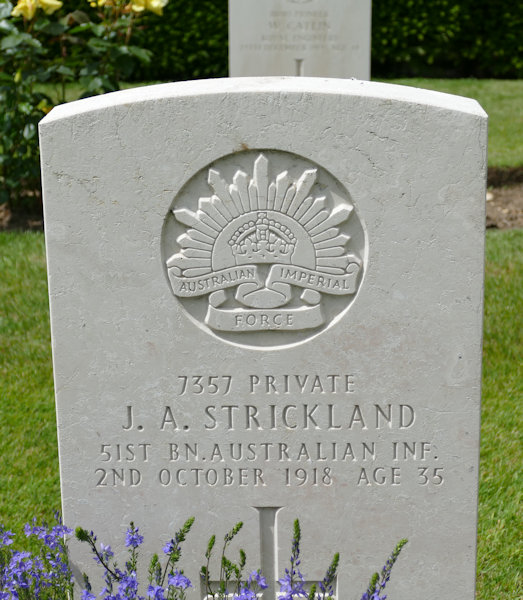
James Alexander Strickland
Conflict
First World War
Date of Death / Age
02/10/1918
35
Rank, Service Number & Service Details
Private
7357
Australian Infantry, A.I.F.
51st Bn.
Awards: Service Medals/Honour Awards
Not Yet Researched
Cemetery/Memorial: Name/Reference/Country
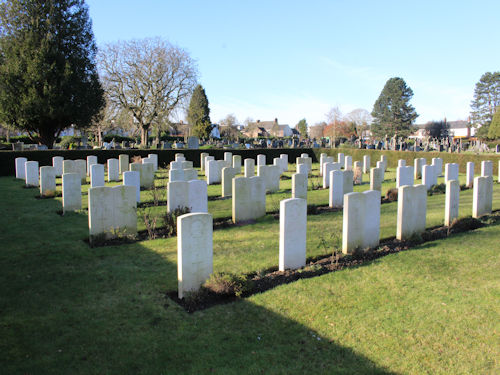
ST. ALBANS (HATFIELD ROAD) CEMETERY
Mil. G. 5.
United Kingdom
Headstone Inscription
Not Researched
UK & Other Memorials
Not on the St Albans memorials (*1)
Biography
James Alexander Strickland was born on 20th May, 1884 at South Yarra, Melbourne, Victoria to parents Reverend Frederick Philip & Ann Alexander Strickland (nee Barry).
The 1910 Australian Electoral Roll for the division of Swan, subdivision of Nelson, Western Australia recorded James Alexander Strickland, Bank Clerk, from Greenbushes.
The 1912 Australian Electoral Roll for the division of Coolgardie, subdivision of Gascoyne, Western Australia recorded James Alexander Strickland, Clerk, from Carnarvon.
James Alexander Strickland married Constance Beatrice Hickson 16th July, 1913 at St. Barnabas Church, Greenbushes, Blackwood, Western Australia. A birth for Phillip Kitchener Alexander Strickland was registered in 1914 at Katanning, Western Australia.
The 1915, 1916 & 1917 Australian Electoral Rolls for the division of Swan, subdivision of Katanning, Western Australia recorded James Alexander Strickland, Bank Officer, of Katanning. His wife – Constance Beatric Strickland, housewife, was listed at Clyde Street, Katanning.
James Alexander Strickland was a 33 year old, married, Accountant (listed by his wife on the Roll of Honour information as Banker with West Australian Bank) from Katanning, Western Australia when he enlisted on 18th April, 1917 with the Australian Imperial Force (A.I.F.). His religion was Church of England & his next of kin was listed as his wife – Mrs C. B. Strickland, of Union Bank, Perth, Western Australia.
Private James Alexander Strickland was posted to D 3 Depot on 1st August, 1917 for recruit training. He was transferred to 22 Depot on 1st October, 1917 then transferred to D 3 Depot on 30th November, 1917. Private Strickland was transferred to 22nd Reinforcements of 28th Battalion on 12th February, 1918.
Private James Alexander Strickland, Service number 7357, embarked from Fremantle, Western Australia on SS Ormonde on 13th March, 1918 with the 28th Infantry Battalion, 22nd Reinforcements & was appointed Acting Lance Corporal on Ormonde on 13th March, 1918. He disembarked at Suez on 4th April, 1918.
28th Battalion
The 28th Battalion was raised at Blackboy Camp in Western Australia on 16 April 1915 from recruits previously earmarked for the 24th Battalion, which was instead being raised in Victoria
(Extract of Battalion information from the Australian War Memorial)
Acting Lance Corporal James Alexander Strickland was taken on strength at Australian Camp at Suez on 4th April, 1918. He was evacuated to Government Hospital at Suez on 9th April, 1918 & was admitted the same day with Measles. Acting Lance Corporal Strickland was discharged to duty to Australian Camp at Suez on 30th April, 1918.
Acting Lance Corporal James Alexander Strickland embarked from Alexandria on H.M.T. Manitou on 3rd May, 1918 & disembarked at Marseilles, France on 11th May, 1918.
Acting Lance Corporal James Alexander Strickland disembarked at Southampton, England on 15th May, 1918 & was marched in to 5th Training Battalion at Fovant, Wiltshire, England the same day. He reverted to the rank of Private on 15th May, 1918.
Reinforcements were only given basic training in Australia. Training was completed in training units in England. Some of these were located in the Salisbury Plain & surrounding areas in the county of Wiltshire.
Private James Alexander Strickland was transferred to 51st Battalion Details (12th Training Battalion) at Codford, Wiltshire on 4th June, 1918 from 28th Battalion (5th Training Battalion).
Private James Alexander Strickland was appointed Acting Corporal on 12th June, 1918 while posted with 12th Training Battalion. He was On Command at Gas School at Chiseldon from 17th June, 1918.
Acting Corporal James Alexander Strickland proceeded overseas to France via Folkestone on 15th August, 1918 from 12th Training Battalion at Codford. He reverted to the rank of Private on proceeding overseas. Private Strickland was marched in to A.I.B.D. (Australian Infantry Base Depot) at Havre, France on 17th August, 1918. He was marched out from A.I.B.D. on 18th August, 1918 to join his Unit & was taken on strength of 51st Battalion in the Field on 20th August, 1916.
Private James Alexander Strickland was wounded in action on 13th September, 1918. He was admitted to 4th Australian Field Ambulance with bullet wound/s to Leg & Thigh. Private Strickland was transferred to Ambulance Train 22 on 13th September, 1918 & was admitted to 12th General Hospital at Rouen, France on 16th September, 1918. He embarked for England on Hospital Ship Carisbrook Castle on 18th September, 1918.
51st Battalion
The 51st Battalion was raised in Egypt in the first week of March 1916, as part of the "doubling" of the AIF. Approximately half of its recruits were Gallipoli veterans from the 11th Battalion, and the other half, fresh reinforcements from Australia. Reflecting the composition of the 11th, the 51st was predominantly composed of men from Western Australia. The battalion became part of the 13th Brigade of the newly-formed 4th Australian Division.....
With the collapse of Russia in October 1917, a major German offensive on the Western Front was expected in early 1918. This occurred in France in late March and the 4th Division moved to defend positions around Dernancourt on the River Ancre. The 51st Battalion assisted in the repulse of a large German attack on 5 April, launching a critical counter-attack late in the day. The German threat remained until late April, and just after 10pm on 24 April 1918, ANZAC Day eve, the 51st began their advance in the now legendary attack to dislodge the enemy from Villers-Bretonneux...
(Extract of Battalion information from the Australian War Memorial)
War Diary – 51st Battalion
POEUILLY 11th September, 1918:
Battalion dispositions as at 8AM attached & marked VII. Fine sunny dat. At 2.30 pm Front line Coys (B & C) advanced on to line of old PERONNE-ST.QUENTIN Railway which was gained by both Coys at 5.30 pm. 1 wounded prisoner & 2 M. Guns were captured. Opposition was slight & our casualties light. Patrols out on our front during the night. Particulars of operation & information gained by patrols see Intelligence Summary.
POEUILLY 12th September, 1918:
Copy of Battalion dispositions as at 8 am attached & marked VIII. Fine sunny day. At 2 pm B Coy on Right & C Coy on left advanced to a depth of 600 yds B Coy capturing 8 prisoners. Patrols out on our front during night (for operations & information see Intelligence Summary).
POEUILLY 13th September, 1918:
Battalion disposition at 8 am attached & marked IX. Enemy shelled Battalion area with “Blue Cross” Gas. A fighting Patrol from “A” Coy captured 2 Officer & 42 o/Ranks prisoners & 6 machine Guns (see Intelligence Summary attached) Bn Hqrs moved to position in cutting on old PERONNE -ST QUENTIN Railway 1000 yds N.E. of VERMAN.
(Extract of War Diary from the Australian War Memorial)
Private James Alexander Strickland was admitted to The County of Middlesex War Hospital, Napsbury, England on 19th September, 1918 with multiple G.S.W. (gunshot wounds) – severe. The Medical Case Sheet for Private J. Strickland recorded “Bomb wound both legs. Bomb 11:9:18 Western Front on Duty.” His condition on 1st October, 1918 was reported as “Much swelling of R Leg from groin to below knee, red painful. Patient sleepless.” An operation was completed on 2nd October, 1918: “Incisions R Thigh – tissues found to be in a condition of Septic gangrene.”
James Alexander Strickland died at 8.45 pm on 2nd October, 1918 at The County of Middlesex War Hospital, Napsbury, St. Albans, England from wounds received in action - G.S.W. to both Legs & Septic Gangrene right Thigh.
A death for James A. Strickland, aged 34, was registered in the December quarter, 1918 in the district of St. Albans, Hertfordshire, England.
A Telegram was sent to Administrative Headquarters, A.I.F., London on 3rd October, 1918 from “Warspital Napsbury St Albans” regarding Private James Alexander Strickland: “Sister Mrs Howe desires funeral of No 7357 Pte STRICKLAND to take place on Monday at 3 pm in St Albans Cemetery AAA Presume this in order and that you will send bearers and firing party as usual AAA”
Private James Alexander Strickland was buried on 7th October, 1918 in Hatfield Road Cemetery, St. Albans, Hertfordshire, England – Plot number Mil. G. 5 and now has a Commonwealth War Graves Commission headstone.
From the burial report of Private James Alexander Strickland - Coffin was good. Polished Elm. The deceased soldier was accorded a Military funeral, Firing Party, Bugler and Pallbearers being in attendance. The coffin was draped with the “Union Jack”, and conveyed to the graveside on a Gun-Carriage, supplied by the A.S.C. Many beautiful wreaths were placed on the coffin. The burial service conducted at the graveside by the Rev: Howarth W. Jones, and the “Last Post” was sounded. The Father of deceased was in attendance, and several other relatives. The grave will be turfed, and an oak cross erected by the A.I.F. London. Administrative Headquarters, A.I.F. London were represented at the funeral.
Names of relatives and friends present at the Funeral – (Sister) Mrs Howe. (Brother-in-law) Flight Cadet Howe, R.A.F. (Father) Mr Strickland.
Private James Alexander Strickland was entitled to British War Medal & the Victory Medal. A Memorial Scroll & Memorial Plaque were also sent to Private Strickland’s widow – Mrs C. B. Strickland, as the closest next-of-kin. (Scroll sent July, 1921 & Plaque sent November, 1922).
Acknowledgments
Gareth Hughes, Jonty Wild, Cathy Sedgwick, Beth Page - https://ww1austburialsuk.weebly.com/