Name
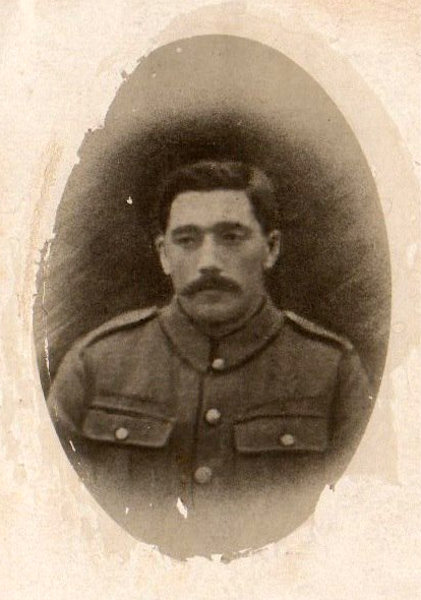
John William Goodwin
1880
Conflict
First World War
Date of Death / Age
31/07/1917
39
Rank, Service Number & Service Details
Private
269127
Hertfordshire Regiment
1st Bn.
Awards: Service Medals/Honour Awards
British War and Victory medals
Cemetery/Memorial: Name/Reference/Country
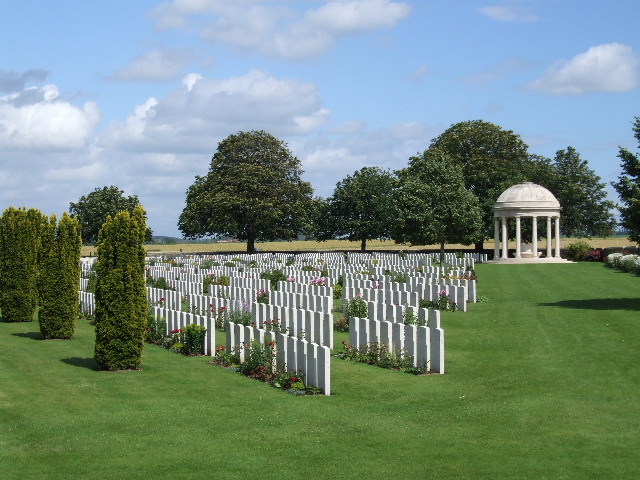
BEDFORD HOUSE CEMETERY
Enclosure No.4 VIII. H. 34.
Belgium
Headstone Inscription
None
UK & Other Memorials
Ashwell Village Memorial, St Mary’s Church Memorial Roll of Honour, Ashwell(*1), Hertfordshire Regimental Memorial, All Saints Church, Hertford, Arlesey Village Memorial Roll of Honour, St Peter's Church, Arlesey, Prudential Assurance Company War Memorial in Holburn, London,
Pre War
John William Goodwin was born in 1880 in Arlesey, Bedfordshire, the son of John and Martha Goodwin (nee Day) and one of six children.
On the 1881 Census the family were recorded living in Davies Row, Arlesey, Beds where his father was working as a bricklayer's labourer. They remained in Arlesey in 1891, then living at Paradise Row. His mother died later the same year and by 1901 John had moved out of the family home and was living as a lodger in Ashwell at the home of Ernest and Emma Searle, and working as a Prudential Insurance Agent. He married Sarah Taylor in 1903 in Biggleswade, Beds and they had three sons, Frederick, Francis and Stanley. On the 1911 Census the family were living at Cleve House, Ashwell and John continued his career as a Prudential Insurance Agent and was well liked and respected. He was also reported to have been a keen athlete.
Wartime Service
John enlisted in Hitchin, Herts on 18 August 1916 and joined the Hertfordshire Regiment.
On 31 July 1917 the 1st Battalion, Hertfordshire Regiment was in support of an attack on the Langemarck Line. A general bombardment of the German lines commenced at 3.45am on 31 July and the planned assault began. It had three objectives to achieve known as Blue, Black & Green and units of the 116th Brigade easily captured the first two objectives, preparing the way for the forward companies of the Hertfordshire battalion, to take the third objective. At 05.00am the Hertfordshires left their assembly positions to attack their objective, which lay over the crest of a ridge.
As they made their way forward they came under heavy fire from both German machine guns and snipers but, after eliminating a German strongpoint, moved up towards St. Julien which was only lightly held. The battalion crossed the Steenbeek with some difficulty and two of its supporting tanks became bogged down in the mud. Things then went from bad to worse. A pre-arranged artillery barrage never materialised due to the guns being unable to move forward over the muddy terrain and the German barbed wire defences, which were fifteen feet deep in some places, were found to still be intact. It was soon realised that ground could only be won by section "rushes" supported by the unit’s own fire.
The Cheshire Regiment were on the right of the battalion but the Black Watch, who were due to cover the left flank, had been seriously delayed. This left the Hertfordshire Regiment seriously exposed and the Germans exploited this by bringing a hurricane of fire down upon the stricken troops. This was followed by a German counter-attack and by 10.30am it was clear that the objective could not be achieved the Herts commenced a withdrawal. The German counter-attacks were stopped, mostly by to Regimental Sergeant Major Sydney Tite's scratch platoon and two volunteers who made stands with Lewis gins to cover the Hertfordshires' retreat. The two volunteers were Corporal Bill Taylor MM, who had been a stretcher bearer with No. 4 Company the year before and to the south Private John William Goodwin, who was 39 on this day. They must have known, that they were unlikely to survive, but continued to fire on the advancing Germans as their comrades in the centre withdrew. John was later reported as Missing in Action. Later his body was found where he had last been seen, firing on the Germans. - perhaps if there had been more surviving witnesses a medal might have been awarded. Bill Taylor had already been decorated with a Military Medal and then received a Bar to his medal.
Casualties were very heavy with 459 men being killed, missing or wounded. (A memorial to the men of the Hertfordshire Regiment now stands just outside the village of Sint Juliaan (St Julien) which was unveiled on 31 July 2017.)
An article in the Hertfordshire Express published on 15 September 1917 stated that John had been missing since the 31 July following the action at St Julien. He was later deemed to have been killed in action on 31 July 1917. At the end of the war his body was later recovered and reburied in Bedford House Cemetery, Belgium.
Additional Information
His widow Sarah received a war gratuity of £3 and pay owing of £1 17s 2d. She also received a pension of £1 6s 3d a week for herself and her three sons. She later lived at Prospect Terrace, Ashwell and 28 London Road, Arlesey, Beds. Their son Frederick was taken prisoner by the Japanese in WWII but survived.
*1 The St Mary's Church Roll of Honour incorrectly indicates that he survived.
N.B. See the Herts at War website for a detailed account of "The Hertfordshires Darkest Day 31/7/1917".
Acknowledgments
Jonty Wild, Derry Warners, Brenda Palmer
Adrian Pitts, Paul Johnson, Jonty Wild