Name
George Gilbert Fleming
1895
Conflict
First World War
Date of Death / Age
24/05/1915
21
Rank, Service Number & Service Details
Private
9983
Royal Fusiliers *1 (London Regiment)
3rd (City of London) Bn.
Awards: Service Medals/Honour Awards
1914 /15 Star, British War and Victory medals
Cemetery/Memorial: Name/Reference/Country
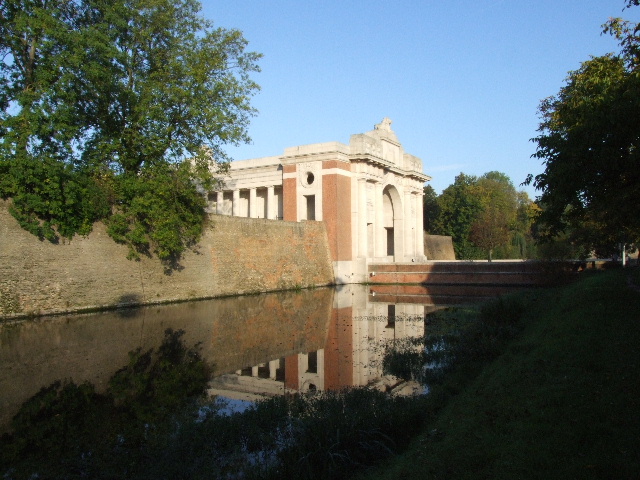
YPRES (MENIN GATE) MEMORIAL
Panel 6 and 8
Belgium
Headstone Inscription
N/A
UK & Other Memorials
Knebworth Village Memorial, Knebworth (Old), St Martin's Church Memorial, Knebworth (New), St Martin's Church Framed Memorial Knebworth (New), The British Legion -Knebworth & District Branch ROH, St Martin Church, Knebworth (New), St Mary & St Thomas Church Memorial, Knebworth Park, Diocese - Book of Remembrance, St Albans Cathedral, St Albans, Diocese of St Albans - ROH, St Albans Cathedral, St Alban
Pre War
George Gilbert Fleming was born in 1895 in Peckham, Camberwell, London, the son of William and Caroline Fleming. He was one of six children, but two died in infancy.
Although not found on the 1901 Census, the family were living at 6 Hellards Road, Stevenage in 1911, where his father was working as a labourer in the motor trade.
After leaving school George worked as a Caddy at Knebworth Golf Club and his parents lived at 9 Gun Lane, Knebworth, Hertfordshire. They later moved to 2 Morven Villas, Pondcroft Road, Knebworth.
Wartime Service
George enlisted in Doncaster and joined the London Regiment. His service number of 9983 suggests he enlisted in late 1911 when he was only 16 and may have been a serving soldier at the outbreak of war but would not have been sent abroad until the age of 19. He served with the 3rd Battalion (otherwise known as the Royal Fusiliers) in France from 13 May 1915 as part of a draft of 300 men and 2 officers who joined the Battalion at Watou, Poperinghe, Belgium on 16 May. The Battalion moved into trenches at Bellewaarde Lake on 21 May and, unbeknown to them, were about to become involved in the Battle of Bellewaarde Ridge.
At 2.45am on 24 May 1915 (Whit Monday), a ferocious German artillery bombardment slammed down on the British V Corps front. The clamour of shells, machine-guns and rifle fire was accompanied by a simultaneous discharge of chlorine gas on almost the entire length of the British line. German infantry assaulted in its wake. Although the favourable wind had alerted the British trench garrison to the likelihood of a gas attack the proximity of the opposing trenches and speed of the enemy assault meant many defenders failed to don their respirators quickly enough and large numbers were overcome. The British defence rallied and the attackers were repelled by small arms fire – except in the north, where Mouse Trap Farm was immediately overrun, and in the south where (by 10am) German infantry broke into the British line north and south of Bellewaarde Lake, where the men of the 3rd Royal Fusiliers were situated. The German break-in around Bellewaarde Lake prompted the commitment of Corps reserve troops – but their arrival took time and the depleted front line battalions had to wait until the early evening before the weakened 84th Brigade was able to attack and turn the enemy out of Witte Poort Farm. Following the belated arrival of 80th Brigade a joint night counter-attack was made after 11pm; this assault, in bright moonlight, was a disaster and both 84th and 80th Brigades suffered heavy casualties. In the early hours of the morning the battle quietened. The following day saw a reduction in shelling and no attempts by the Germans to renew the offensive. The Battalion had suffered horrendous casualties with 552 Officers & Men being Killed, Wounded or Missing.
George, aged 21, who was in action for the first time, was never seen again and death was presumed on or since 24 May 1915. He has no known grave and his name is commemorated on the Ypres (Menin Gate) Memorial, Belgium.
Additional Information
His father received a war gratuity of £3 and pay owing of £2 12s 6d. A pension card exists which states that his mother received a gratuity rather than a pension, but then seems to indicate that a pension of 4s 6d a week was paid, initially which later rose to 5 shillings a week.
*1 3rd (City of London) Bn. London Regiment (Royal Fusiliers).
Acknowledgments
Brenda Palmer
Paul Johnson